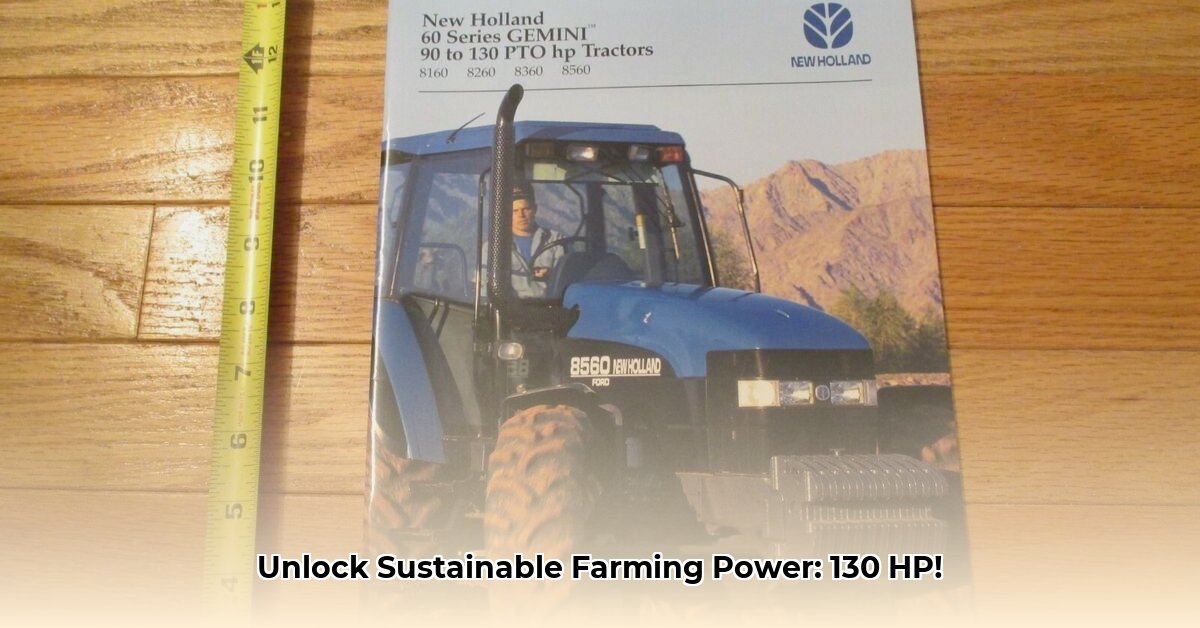
New Holland TS6.130 Tractor: A Detailed Review for Sustainable Farming
Choosing the right tractor is a crucial investment for any farm. This review analyzes the New Holland TS6.130, a 130-horsepower machine designed for efficient and sustainable farming practices. We'll examine its performance, features, and overall value proposition, providing actionable intelligence to help farmers make informed decisions. For more information on New Holland tractors, visit the official website.
Power, Performance, and Fuel Efficiency: A Deep Dive
The TS6.130 boasts 130 horsepower, sufficient for most farm tasks. Its high power-to-weight ratio minimizes soil compaction, promoting healthy crop growth and higher yields—a key factor in sustainable agriculture. The 4-cylinder turbo-diesel engine promises fuel efficiency, but real-world data is crucial. Comparative fuel consumption figures (liters per hectare) against competitors like John Deere and Case IH are needed for a comprehensive assessment. How much fuel can this tractor really save you compared to similar models? Independent testing is necessary to quantify these savings.
Transmission Options and Ease of Use: Smooth Operations?
The TS6.130 offers two transmission options: an 8x8 synchronized hydraulic shuttle and a 16x8 power shuttle with Hi-Lo. The 16x8 provides greater flexibility for varying field conditions. A 10:1 creeper gear enhances precision for tasks like planting and spraying. However, real-world assessments of smoothness, responsiveness, and ease of maintenance are needed. How user-friendly are these transmissions in daily operation? Feedback from experienced farmers would be valuable in this regard.
Operator Comfort, Visibility, and Safety: A Productive Workspace
The New Holland VisionView™ cab prioritizes operator comfort. A comfortable operator translates directly to increased productivity and reduced fatigue. But how does this cab really stack up against the competition in terms of ergonomics and long-term comfort? While the high-visibility roof panel is a significant safety enhancement, particularly with front loader use, a thorough review should include assessments of other safety features and ergonomics.
Versatility and Implement Compatibility: Adaptability in Action
The TS6.130's 3-point hitch system and 62.5 GPM hydraulic flow rate support a wide range of implements. This versatility reduces the need for specialized tractors, resulting in cost savings and operational efficiency. The adjustable front and rear axles further enhance adaptability to varying terrains. How quickly and easily can implements be changed? Evaluations of the attachment system's efficiency are critical for time-saving assessments.
Cost of Ownership: A Long-Term Perspective
The initial purchase price is only one element of the total cost of ownership (TCO). Comprehensive pricing information, along with comparisons to John Deere and Case IH models with similar specifications, is needed. Maintenance costs—parts, repairs, and service intervals—must be factored into the TCO calculation. What is the realistic five-to-ten-year cost of ownership for this tractor? A detailed TCO analysis, considering depreciation and potential resale value, is essential for a truly informed decision.
Comparative Analysis: How Does it Measure Up?
| Feature | New Holland TS6.130 | John Deere Equivalent | Case IH Equivalent |
|---|---|---|---|
| Horsepower | 130 | (Data needed) | (Data needed) |
| Fuel Efficiency (l/ha) | (Data needed) | (Data needed) | (Data needed) |
| Transmission Options | 8x8, 16x8 power shuttle | (Data needed) | (Data needed) |
| Price (USD) | (Data needed) | (Data needed) | (Data needed) |
| Typical Annual Maintenance Costs (estimate) | (Data needed) | (Data needed) | (Data needed) |
This table requires thorough research to fill in the missing data for an accurate comparison.
Sustainability: Environmental Impact Assessment
Assessing the TS6.130's sustainability requires a holistic approach, going beyond fuel efficiency. This involves analyzing the manufacturing process, material sourcing, transportation emissions, and end-of-life management. What is the tractor's overall carbon footprint compared to its competitors? Quantifiable data on greenhouse gas emissions throughout the tractor's lifecycle is crucial for a complete sustainability evaluation.
Actionable Intelligence: Making Informed Decisions
To effectively evaluate the New Holland TS6.130, gather the following:
Obtain detailed fuel consumption data: Conduct independent testing to compare fuel efficiency to competitor models. Target a metric of liters per hectare for accurate comparison.
Analyze long-term maintenance costs: Secure data regarding parts availability, common repair issues, and service intervals to estimate long-term maintenance expenditures.
Perform a comprehensive TCO analysis: Use available tools and resources to create a detailed TCO model, incorporating all relevant costs over the tractor's projected lifespan (1).
Pros:
- High power-to-weight ratio minimizing soil compaction.
- Versatile transmission options for diverse tasks.
- Comfortable and safe VisionView™ cab.
- High hydraulic flow rate for implement compatibility.
Cons:
- Insufficient comparative data on fuel efficiency and TCO.
- Long-term maintenance costs require further investigation.
- Comprehensive sustainability assessment is needed.
Conclusion:
The New Holland TS6.130 shows promise as a powerful and versatile tractor. However, crucial data gaps remain. Thorough independent testing, comparative analysis, and a complete TCO evaluation are necessary before making a definitive judgment on its suitability for individual farms. The information presented here provides a starting point for further investigation and critical analysis.